
BPO · Practical guide
What Is Learning Outsourcing? A Practical Scope Guide
Choose a manageable outsourcing scope by separating learning strategy, recurring administration, content operations and platform responsibilities.
By Cyberwisdom Group · Learning operations editorial
What does learning outsourcing mean?
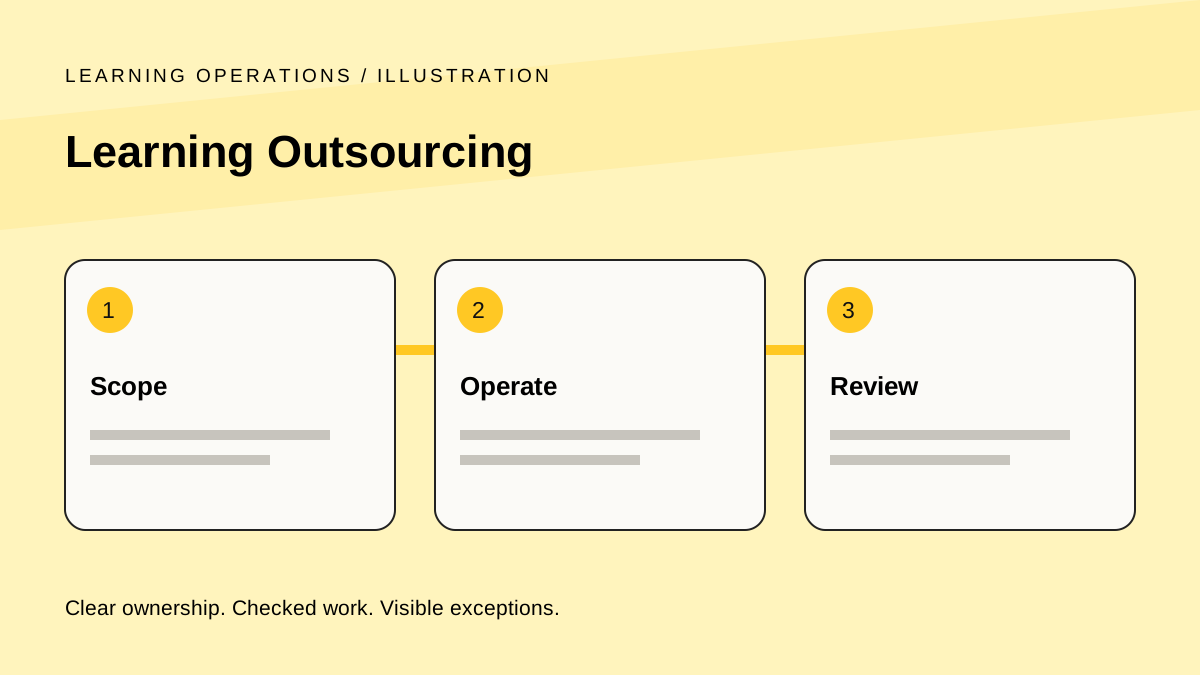
Learning outsourcing delegates agreed learning activities to an external provider. In an operating service, the focus is the recurring work behind training: processing requests, coordinating sessions, maintaining learning records, publishing approved content and preparing reports. The organization still decides why learning is needed, who must take it and how success should be judged.
A useful starting point is the work queue rather than the software. Which requests arrive each week? Who approves them? Which steps depend on information from another team? A clear answer makes it possible to compare providers on the same scope instead of comparing vague promises about end-to-end support.
Separate the decisions from the execution
Your retained learning owner should approve priorities, target audiences and learning policy. Finance or procurement retains the relevant budget and purchasing approvals. Content owners approve course material and versions. IT and the platform supplier retain the technical responsibilities assigned to them. A service provider can perform defined operations without taking over these decisions.
This distinction also prevents a common misunderstanding: buying managed learning services does not automatically mean replacing the LMS. An existing platform may remain in place while an external team operates permitted administrative functions. The practical limits depend on roles, licensing, workflows and the service provider’s assessed ability to support that environment.
Choose one operating problem first
Start with a process that has a recognizable input and output. For enrollment administration, the input might be an approved participant list and assignment rules. The output is a checked enrollment record plus an exception list. For reporting, the input might be a dated data extract and agreed definitions; the output is a reconciled management pack.
Avoid putting every unresolved problem into the initial contract. A backlog cleanup, a platform upgrade and a recurring operating service create different kinds of work. Identify them separately so that transition effort does not disappear inside a monthly service assumption.
Compare partial and broader outsourcing
A partial service can support one queue or program while the internal team keeps adjacent work. It can be easier to define and review, but the interfaces still need owners. Someone must supply approved data, answer exceptions and accept the result. Delegating only execution does not remove those customer responsibilities.
A broader arrangement can combine administration, learner support, content operations and reporting. It requires more detailed coordination because one task may affect several others. A late content approval can delay assignments; a user-data issue can affect both support demand and completion reporting. The service review should show these dependencies rather than treating every delay as the same type of failure.
Ask for evidence that matches the work
Do not measure an operating service only by the number of tickets closed. A closure can be premature if the learner still cannot access the course. Pair throughput with quality checks, rework, unresolved exceptions and confirmation that the requested action was completed correctly. Definitions matter more than an impressive dashboard.
For a pilot, select representative tasks with known inputs. Agree what evidence the reviewer needs, who accepts the output and what happens if the work fails the check. The pilot should expose unclear instructions and access gaps before a larger volume depends on the new arrangement.
Build a quote from demand and coverage
User count gives context but does not describe the whole workload. Ask for the expected monthly volume of enrollments, sessions, content changes, support requests and reports. Include languages, coverage hours, approval complexity and the likely exception rate. Separate steady demand from seasonal campaigns and one-time backlog work.
For example, an illustrative regional onboarding service might begin with one cohort and a monthly reporting cycle. The customer approves the audience and course rules; the provider processes the agreed tasks and reports missing information. Expansion follows a review of the actual work and acceptance evidence, rather than an assumption that the pilot proves every future workflow.
Your next scope conversation
Bring a list of recurring tasks, the current LMS and modules, learner groups, demand estimates and the decisions you intend to retain. Add the people who own access, policy and final acceptance. These practical inputs support a useful service discussion even if a complete requirements document does not yet exist.
Cyberwisdom’s Managed Learning Services sit within its broader BPO offering. The service scope can be discussed around existing learning operations, with platform access and responsibilities assessed before an operating commitment is made.
Explore the related services
Discuss the work you want to delegate
Tell us which LMS you use, who you support, the recurring tasks and the service coverage you need. We can scope an operating service around the work.
Discuss your learning operations ↗