
Scope the service
Map requests, volumes, approvals and handoffs before deciding which work to delegate.
Output: A service catalog with owners, inputs and acceptance criteria.
BPO · Learning Outsourcing
Learning outsourcing gives an external team responsibility for agreed training operations while your organization retains learning priorities, policy and approval authority.
Discuss your service scope ↗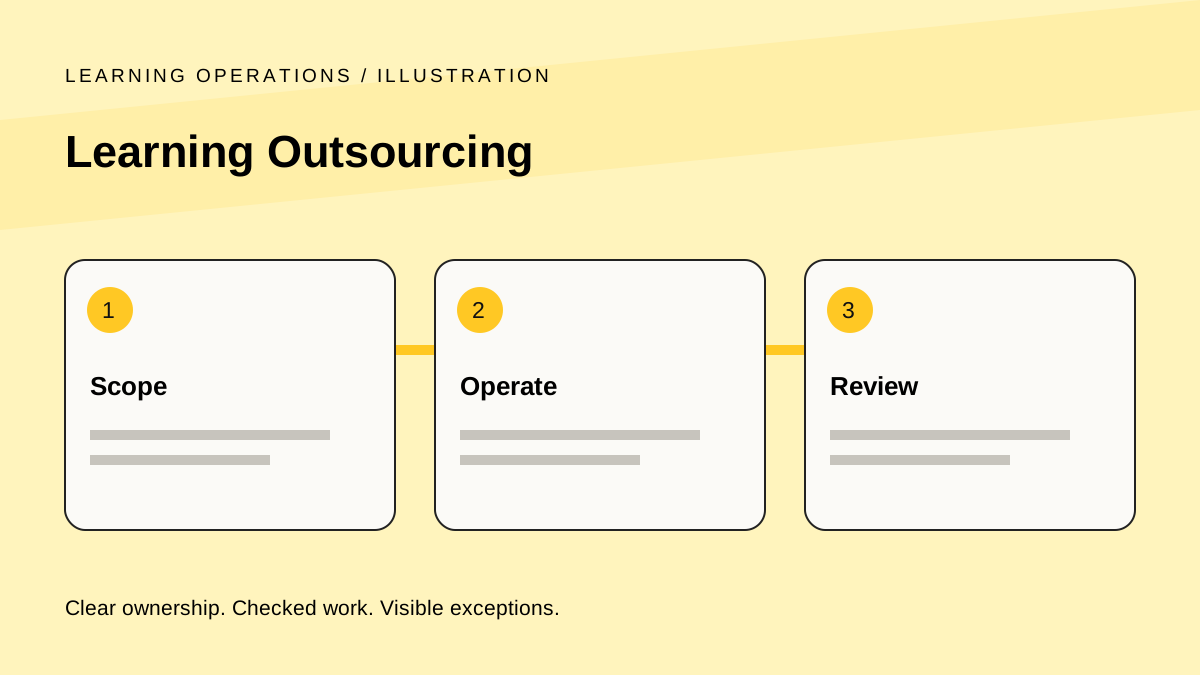
An overloaded L&D team needs a repeatable operating service, rather than another platform purchase.
You can retain your existing learning platform and delegate a defined set of operating tasks. We assess the platform, permissions and workflow during discovery before agreeing which work can be supported.
Map requests, volumes, approvals and handoffs before deciding which work to delegate.
Output: A service catalog with owners, inputs and acceptance criteria.
Coordinate the agreed combination of administration, content operations, support and reporting.
Output: A visible work queue with status, owner and exceptions.
Review demand, quality, rework and recurring delays with the retained learning owner.
Output: An action log with decisions, owners and review dates.
Your team retains learning strategy, budget approval and policy decisions. Training design, facilitation, technology replacement and specialist consulting are separate scope decisions.
| Customer retains | Managed service operates | Specialists handle |
|---|---|---|
| Policy, priorities, access approval and final acceptance. | Agreed requests, runbooks, quality checks and exception reporting. | Platform engineering, policy interpretation and separately scoped changes. |
Illustrative scenario
A regional team could delegate enrollment and monthly reporting first, then add content publishing after checking access and service quality.
Before wider rollout, agree a representative sample, review the completed work against source instructions and record any unresolved dependency. This example explains the operating method; it is not a named client case or a promised result.
User count is only one input. A small population with frequent changes or complex approvals can create more operating work than a larger, stable population. Commercial scope follows the workload, coverage and responsibilities agreed together.
No platform replacement is required as a starting assumption. Support for your existing environment is assessed against its administrative tools, permissions and the tasks you want to delegate.
Agree acceptance criteria, sample checks, exception ownership and a review cadence before the service starts. Response targets and coverage hours belong in the service agreement.
A defined workflow or cohort can be considered for a pilot. Its boundaries, access and acceptance evidence must be clear before responsibility transfers.
Tell us which LMS you use, who you support, the recurring tasks and the service coverage you need. We can scope an operating service around the work.
Discuss your learning operations ↗