
Prepare the cohort
Confirm the approved participant list, eligibility rules, capacity and joining instructions.
Output: A reconciled enrollment list and a record of exceptions.
BPO · Managed Training Administration
Managed Training Administration is the coordinated handling of course setup, bookings, enrollment, learner communications and training records against approved instructions.
Discuss your service scope ↗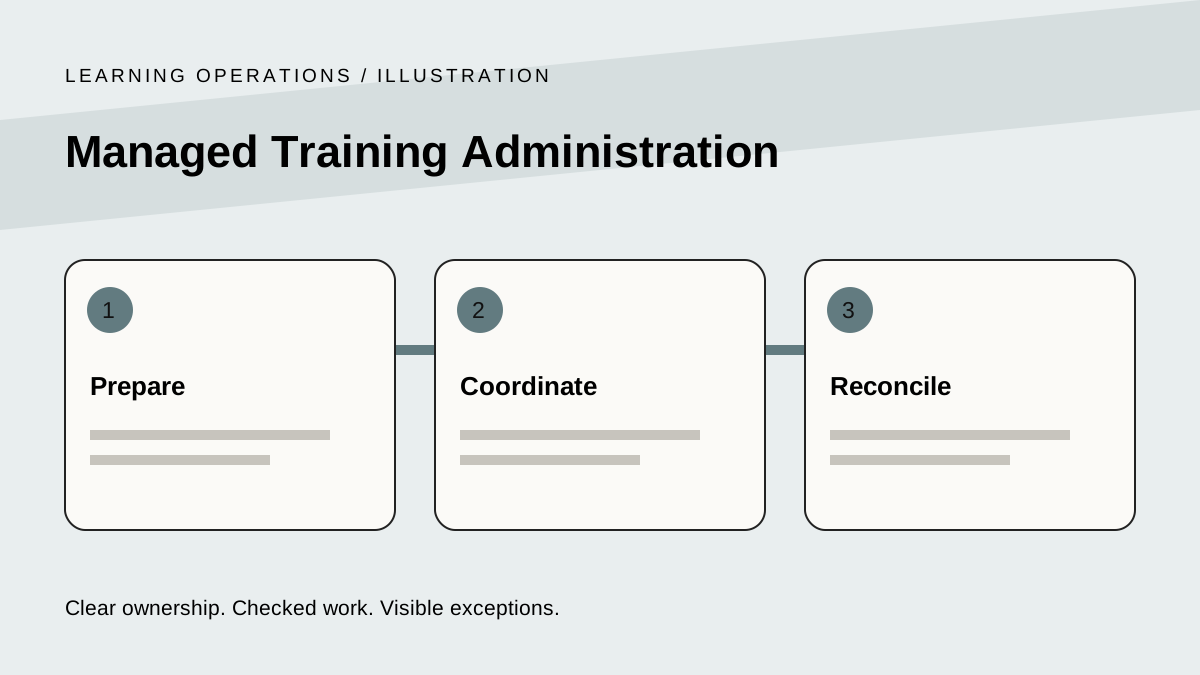
Program managers spend too much time checking bookings and reconciling attendance instead of improving learning.
You can retain your existing learning platform and delegate a defined set of operating tasks. We assess the platform, permissions and workflow during discovery before agreeing which work can be supported.
Confirm the approved participant list, eligibility rules, capacity and joining instructions.
Output: A reconciled enrollment list and a record of exceptions.
Issue agreed communications, manage changes and keep the trainer and course owner informed.
Output: A session administration checklist and change log.
Reconcile attendance and completion evidence, then route unresolved items for approval.
Output: A closed-session record with missing evidence identified.
The customer approves eligibility, budgets and attendance correction rules. Administration does not include teaching, travel purchasing or expense authorization unless explicitly agreed.
| Customer retains | Managed service operates | Specialists handle |
|---|---|---|
| Policy, priorities, access approval and final acceptance. | Agreed requests, runbooks, quality checks and exception reporting. | Platform engineering, policy interpretation and separately scoped changes. |
Illustrative scenario
For a monthly onboarding cohort, administrators reconcile new starters, issue session instructions and return attendance exceptions to the program owner.
Before wider rollout, agree a representative sample, review the completed work against source instructions and record any unresolved dependency. This example explains the operating method; it is not a named client case or a promised result.
User count is only one input. A small population with frequent changes or complex approvals can create more operating work than a larger, stable population. Commercial scope follows the workload, coverage and responsibilities agreed together.
No platform replacement is required as a starting assumption. Support for your existing environment is assessed against its administrative tools, permissions and the tasks you want to delegate.
Agree acceptance criteria, sample checks, exception ownership and a review cadence before the service starts. Response targets and coverage hours belong in the service agreement.
A defined workflow or cohort can be considered for a pilot. Its boundaries, access and acceptance evidence must be clear before responsibility transfers.
Tell us which LMS you use, who you support, the recurring tasks and the service coverage you need. We can scope an operating service around the work.
Discuss your learning operations ↗