Capture reproducible evidence
Record the issue, environment, affected users, timing and steps within permitted access.
Output: An incident record with relevant screenshots or logs.
BPO · LMS Technical Support and Coordination
LMS technical coordination captures and triages operational incidents, gathers evidence and coordinates escalation between administrators, internal IT, content owners and the platform supplier.
Discuss your service scope ↗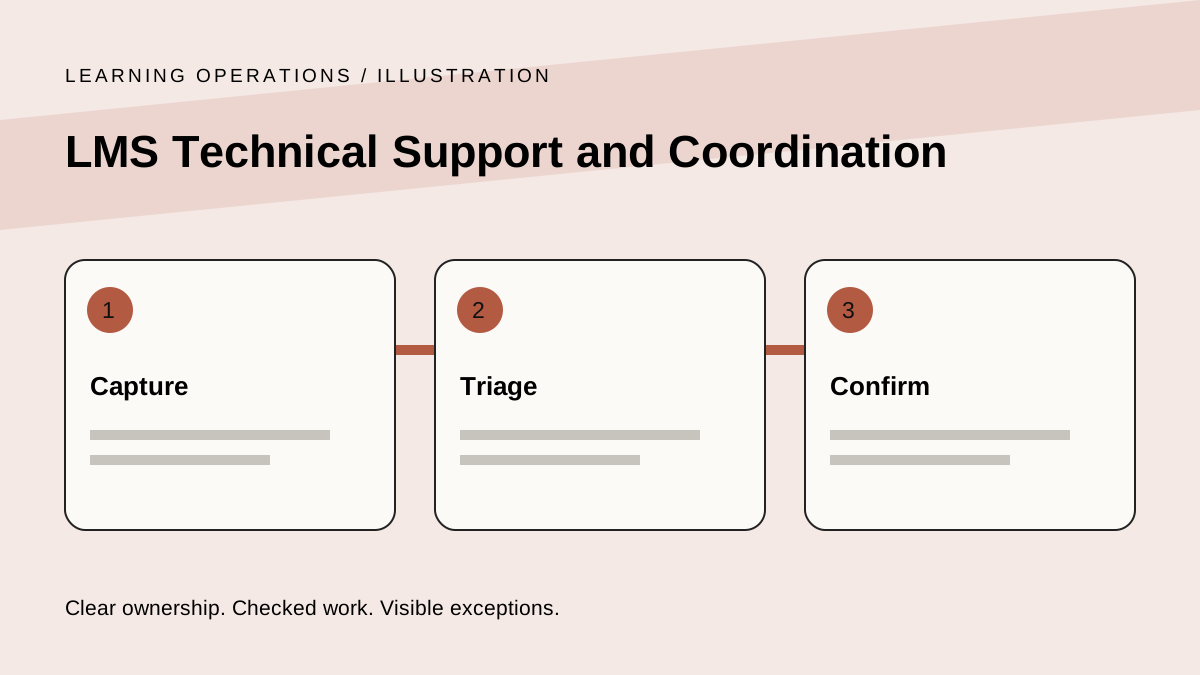
Problems bounce between support teams because each receives incomplete context and unclear ownership.
You can retain your existing learning platform and delegate a defined set of operating tasks. We assess the platform, permissions and workflow during discovery before agreeing which work can be supported.
Record the issue, environment, affected users, timing and steps within permitted access.
Output: An incident record with relevant screenshots or logs.
Distinguish routine administration, content behavior, identity/access and platform defects.
Output: A named resolver and documented escalation route.
Coordinate validation after the responsible team provides a fix or approved workaround.
Output: A resolution record and any updated runbook steps.
Software patches, infrastructure administration, penetration testing, integration changes and vendor engineering remain with the responsible specialists unless separately contracted. Resolution time depends on severity and third-party dependencies.
| Customer retains | Managed service operates | Specialists handle |
|---|---|---|
| Policy, priorities, access approval and final acceptance. | Agreed requests, runbooks, quality checks and exception reporting. | Platform engineering, policy interpretation and separately scoped changes. |
Illustrative scenario
A course tracking incident can be checked against the package version and LMS settings before the supplier receives an escalation with repeatable steps.
Before wider rollout, agree a representative sample, review the completed work against source instructions and record any unresolved dependency. This example explains the operating method; it is not a named client case or a promised result.
User count is only one input. A small population with frequent changes or complex approvals can create more operating work than a larger, stable population. Commercial scope follows the workload, coverage and responsibilities agreed together.
No platform replacement is required as a starting assumption. Support for your existing environment is assessed against its administrative tools, permissions and the tasks you want to delegate.
Agree acceptance criteria, sample checks, exception ownership and a review cadence before the service starts. Response targets and coverage hours belong in the service agreement.
A defined workflow or cohort can be considered for a pilot. Its boundaries, access and acceptance evidence must be clear before responsibility transfers.
Tell us which LMS you use, who you support, the recurring tasks and the service coverage you need. We can scope an operating service around the work.
Discuss your learning operations ↗