
Confirm requirements
Collect delivery format, capacity, trainer availability, time zones and accessibility needs.
Output: A checked session brief and scheduling assumptions.
BPO · Training Scheduling and Coordination
Training coordination connects schedules, trainers, participants, venues or virtual sessions so that approved training can be delivered with clear instructions and controlled changes.
Discuss your service scope ↗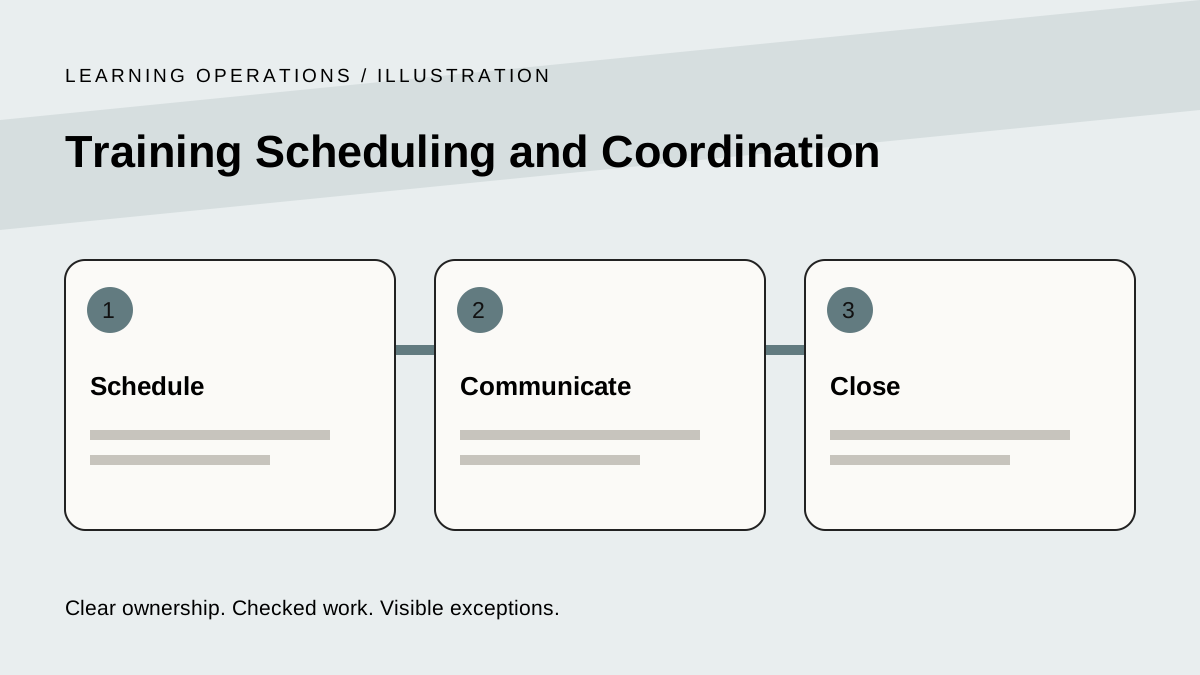
Session changes are scattered across spreadsheets, inboxes and calendars, creating avoidable confusion.
You can retain your existing learning platform and delegate a defined set of operating tasks. We assess the platform, permissions and workflow during discovery before agreeing which work can be supported.
Collect delivery format, capacity, trainer availability, time zones and accessibility needs.
Output: A checked session brief and scheduling assumptions.
Maintain the approved schedule and circulate joining instructions and agreed reminders.
Output: A versioned calendar with participant communications.
Record cancellations, substitutions and rescheduling decisions and reconcile final attendance.
Output: A change record and a session closure pack.
Trainer contracting, venue commitments, payments and travel approvals remain with designated owners unless specifically delegated. Scheduling support does not guarantee trainer availability.
| Customer retains | Managed service operates | Specialists handle |
|---|---|---|
| Policy, priorities, access approval and final acceptance. | Agreed requests, runbooks, quality checks and exception reporting. | Platform engineering, policy interpretation and separately scoped changes. |
Illustrative scenario
For a multi-location workshop, the coordinator confirms local session times, routes a trainer substitution for approval and updates the participant instructions.
Before wider rollout, agree a representative sample, review the completed work against source instructions and record any unresolved dependency. This example explains the operating method; it is not a named client case or a promised result.
User count is only one input. A small population with frequent changes or complex approvals can create more operating work than a larger, stable population. Commercial scope follows the workload, coverage and responsibilities agreed together.
No platform replacement is required as a starting assumption. Support for your existing environment is assessed against its administrative tools, permissions and the tasks you want to delegate.
Agree acceptance criteria, sample checks, exception ownership and a review cadence before the service starts. Response targets and coverage hours belong in the service agreement.
A defined workflow or cohort can be considered for a pilot. Its boundaries, access and acceptance evidence must be clear before responsibility transfers.
Tell us which LMS you use, who you support, the recurring tasks and the service coverage you need. We can scope an operating service around the work.
Discuss your learning operations ↗